Today was the last day for two of my classes (the third ended on Tuesday), and as burnt-out as I've been feeling for the last two weeks and as uninterested as I've been in planning classes for at least as long*, last night I found myself getting suddenly energized as I tried to figure out how to wrap things up today. And by "wrap things up," I don't mean "plan a final 1.5-hour-long class meeting"; no, I mean "come up with a sufficiently conclusory three-minute speech"--one that would tie together everything we'd done and send my students out into the future feeling they'd accomplished something (and possibly with some interest in taking additional courses in my period).
Sometimes I take the quick and dirty route, as I did with my Comp class--in 60 seconds I reminded them of the many things they'd done this semester and the specific skills I'd seen them develop; told them that this was only the beginning of their writing careers; encouraged them to take more English courses; and thanked them for being a great class.
But with others I try much harder. In the three semesters that I've been teaching Brit Lit I, I've gone to great lengths to create a meaningful conclusion that--as with the best written conclusions--isn't so much a recap as a graceful suggestion of why what we've done might matter, and where it might lead us. (I had a great bit that I did at Big Urban, where the class ended with Paradise Lost, but at RU the survey goes just a bit further, so I had to come up with something new.)
I know that these perorations are a little cheesy, and that they're more about theatre than about content. I remember the first class that I TAed for as a grad student, and how the students clapped for the professor at end of the final lecture. As they were clapping, I turned to one of my fellow (but older and more experienced) TAs to observe that there didn't seem to be a meaningful pattern to which classes got applause, and which didn't--I'd seen classes fail to applaud a wildly popular professor at the end of a wildly popular course, and I'd seen them applaud at the end of a fairly humdrum one. My friend half-smiled, shrugged and said, "if you end right, you can always make them clap."
I was puzzled by that when he said it, but I've since come to see that it's usually true: you slow down your speech and emphasize just the right words, widen your eyes and put on the sincere face, and if you hit that last sentence just right, and then pause--well, unless it's a small class, or unless applauding isn't part of the campus culture, the response can be almost Pavlovian.**
So I do feel slightly fraudulant when I swing (with all apparent naturalness, as if this were just totally off the cuff) into such wrap-ups, but at the same time I think that students both like them and benefit from them. No, it's not as if my students would have learned any less over the course of the semester if I didn't take the time to remind them of what they'd learned, and it's not as if sending them off with an idea to chew over or a nice frame to put around the material we've covered means they've learned any more, but I think students do feel that they've learned more, and learned something more meaningful, when there's some kind of take-away. As a result, I believe they're more likely to take challenging or unfamiliar classes in the future and to believe in their own intellectual abilities.
And anyway: if I'm a fraudulent cheeseball, at least I'm in love with my own cheesiness and fakery. They may be artificial, these perorations, but as I deliver them I convince myself of their truth all over again.
-----------------------------------
*Best solution ever? Student research presentations for the last three class meetings! Worst solution ever? Teaching a work I'd never taught before--and had only read once, long ago--over the last two class meetings. And yes, I did both of these things this semester.
**For the record: no, none of my classes this semester clapped. But there were lots of thoughtful nods, reflective looks, and smiles throughout.
Thursday, December 07, 2006


Saturday, December 02, 2006
Minor practical and ethical dilemma
So I'm going to MLA again this year, mainly because George Washington Boyfriend is on the market, but also because it's not in a totally inconvenient location relative to the rest of my winter break plans, and because I do enjoy many of the panels, catching up with friends and professional acquaintances, &c.
But I haven't registered yet. What with that whole four-months-without-a-salary, moving-to-a-new-location-and-setting-up-house thing, I'm in pretty tight financial straits, and I just couldn't afford to pay the $125 early registration fee last month; I figured it would be easier to pay the full $150 fee later this month. But now, looking ahead to my projected expenses, I'm not even so sure about that.
I'm thinking about not registering at all.
Practically, I don't think that this would pose too much of a problem. GWB and I already have a hotel room, and in my past experience I don't recall nametages being regularly checked by MLA staff; I think they're really only strict at the book exhibit and at the big, "future-of-the-humanities"-type panels. The panels I'm interested in will likely draw between 5-40 people, and I'm pretty sure that security at the INRU reception isn't too tight, since I know people from other programs who have crashed it in past years (full, open bar, folks--'swhat I'm talking about!).
But perhaps I'm misremembering how strict nametag enforcement is, and there are a couple of panels that I'd be really disappointed if I got shut out of. And if part of the reason for going is to schmooze, maybe it's better to have the damn tag already. And there is, of course, the ethical question: could I be a good professional citizen and still be a conference freeloader?
Thoughts?
But I haven't registered yet. What with that whole four-months-without-a-salary, moving-to-a-new-location-and-setting-up-house thing, I'm in pretty tight financial straits, and I just couldn't afford to pay the $125 early registration fee last month; I figured it would be easier to pay the full $150 fee later this month. But now, looking ahead to my projected expenses, I'm not even so sure about that.
I'm thinking about not registering at all.
Practically, I don't think that this would pose too much of a problem. GWB and I already have a hotel room, and in my past experience I don't recall nametages being regularly checked by MLA staff; I think they're really only strict at the book exhibit and at the big, "future-of-the-humanities"-type panels. The panels I'm interested in will likely draw between 5-40 people, and I'm pretty sure that security at the INRU reception isn't too tight, since I know people from other programs who have crashed it in past years (full, open bar, folks--'swhat I'm talking about!).
But perhaps I'm misremembering how strict nametag enforcement is, and there are a couple of panels that I'd be really disappointed if I got shut out of. And if part of the reason for going is to schmooze, maybe it's better to have the damn tag already. And there is, of course, the ethical question: could I be a good professional citizen and still be a conference freeloader?
Thoughts?
Wednesday, November 29, 2006
Students never change. Except when they do.
Like many of my readers, I took a big, fat stack of essays with me on my Thanksgiving travels, and while I got through as many as I needed to, in order to face my students this week, I certainly didn't get through all of them.
I find myself grading more slowly these days, oppressed by encountering the same mistakes and writing the same comments over and over again. I try to remind myself that this student hasn't yet had me make that correction on a paper, and that I need to explain myself as clearly as if his were the first paper I'd ever seen with that particular citation error, or a heap of sentence fragments, or a paragraph that ended up being about something completely different than whatever its first sentence promised.
It's a struggle, and I understand why crotchety older faculty sometimes insist that college students are getting stupider: when you see the exact same problems, semester after semester, it's easy to foget that most individual students do improve, sometimes quite dramatically.
I keep telling myself this, and I think it's been changing the kinds of comments that I make on my students' papers. Here's an example: I read an essay that did a fairly nice comparative reading of two of Shakespeare's sonnets; it was a solid, respectable B (which for an essay in my class is pretty good), but the last page veered completely off track into an explanation of how relevant these poems are to us today, and how true to life, and how many examples of this situation we can see around us in the world today.
In the past, I would simply have slashed out those two or three paragraphs with my pen, written "inappropriate" in the margin, and moved on.
This time, reminding myself that many of my students don't have a stable sense of what is and isn't appropriate in a literature essay--and reminding myself, further, that this particular student was a sophomore and had chosen a rather challenging topic--I wrote something like, "This is all true, and I'm glad that you're so personally invested in this subject. However, this isn't appropriate in a formal essay. You'd have done better to use this last page to expand upon how the poetic devices that you so nicely identify on page 4 actually work within the poem."
(Yeah. You can see why it's taking me longer to grade these days.)
I'm not an especially patient person, and neither am I, by nature, a validator. My knee-jerk reflex isn't to say, charitably, "well, I can tell that you're really passionate about this topic, Suzy!" but rather to think, "Jesus Christ. What kind of stupid person would say that?" But I've been forcing myself to be more patient, in part because I've inadvertently learned a little more about the academic histories of some of my most impressive students.
Let's start with Liz, a senior, who is unquestionably my smartest and most thoughtful student this semester; it didn't surprise me to learn that she was applying to grad schools in English and that faculty members were practically fighting to write her recommendation letters. What did surprise me was when I met with her to talk about her applications, and I learned that she'd started her college career in the honors program at a nearby university, flunked out within a year, spent a couple of semesters at a community college, begged her way into Regional U. . . and has gotten nothing but straight As ever since.
Another one of my standout students did indifferently well in high school, fucked around for several years afterwards--but since starting at RU has gotten nearly perfect grades in his two majors while also holding down a full-time job. He rocked the LSAT and has gotten into several top-10 law schools.
Those are two students who have volunteered information about their academic histories. But as I look at the transcripts for my other top students, I see a similar pattern more times than not: this one got all Cs her first year. That one failed or withdrew from as many classes as she passed until her junior year, when suddenly her grades become all As and Bs.
I don't know what happened with those students--family or personal crises? Not ready for college? Stuck in the wrong major? I have no idea. But the fact that so many of my best students have chequered careers is reminding me that this year's C student might, next year, be the student who drops by my office just to boast about how she'd talked her way into the rare books room at the local R1 because she wanted to hold their 1855 edition of Leaves of Grass in her hands.
And even if she won't be, I need to treat her as if she could.
I find myself grading more slowly these days, oppressed by encountering the same mistakes and writing the same comments over and over again. I try to remind myself that this student hasn't yet had me make that correction on a paper, and that I need to explain myself as clearly as if his were the first paper I'd ever seen with that particular citation error, or a heap of sentence fragments, or a paragraph that ended up being about something completely different than whatever its first sentence promised.
It's a struggle, and I understand why crotchety older faculty sometimes insist that college students are getting stupider: when you see the exact same problems, semester after semester, it's easy to foget that most individual students do improve, sometimes quite dramatically.
I keep telling myself this, and I think it's been changing the kinds of comments that I make on my students' papers. Here's an example: I read an essay that did a fairly nice comparative reading of two of Shakespeare's sonnets; it was a solid, respectable B (which for an essay in my class is pretty good), but the last page veered completely off track into an explanation of how relevant these poems are to us today, and how true to life, and how many examples of this situation we can see around us in the world today.
In the past, I would simply have slashed out those two or three paragraphs with my pen, written "inappropriate" in the margin, and moved on.
This time, reminding myself that many of my students don't have a stable sense of what is and isn't appropriate in a literature essay--and reminding myself, further, that this particular student was a sophomore and had chosen a rather challenging topic--I wrote something like, "This is all true, and I'm glad that you're so personally invested in this subject. However, this isn't appropriate in a formal essay. You'd have done better to use this last page to expand upon how the poetic devices that you so nicely identify on page 4 actually work within the poem."
(Yeah. You can see why it's taking me longer to grade these days.)
I'm not an especially patient person, and neither am I, by nature, a validator. My knee-jerk reflex isn't to say, charitably, "well, I can tell that you're really passionate about this topic, Suzy!" but rather to think, "Jesus Christ. What kind of stupid person would say that?" But I've been forcing myself to be more patient, in part because I've inadvertently learned a little more about the academic histories of some of my most impressive students.
Let's start with Liz, a senior, who is unquestionably my smartest and most thoughtful student this semester; it didn't surprise me to learn that she was applying to grad schools in English and that faculty members were practically fighting to write her recommendation letters. What did surprise me was when I met with her to talk about her applications, and I learned that she'd started her college career in the honors program at a nearby university, flunked out within a year, spent a couple of semesters at a community college, begged her way into Regional U. . . and has gotten nothing but straight As ever since.
Another one of my standout students did indifferently well in high school, fucked around for several years afterwards--but since starting at RU has gotten nearly perfect grades in his two majors while also holding down a full-time job. He rocked the LSAT and has gotten into several top-10 law schools.
Those are two students who have volunteered information about their academic histories. But as I look at the transcripts for my other top students, I see a similar pattern more times than not: this one got all Cs her first year. That one failed or withdrew from as many classes as she passed until her junior year, when suddenly her grades become all As and Bs.
I don't know what happened with those students--family or personal crises? Not ready for college? Stuck in the wrong major? I have no idea. But the fact that so many of my best students have chequered careers is reminding me that this year's C student might, next year, be the student who drops by my office just to boast about how she'd talked her way into the rare books room at the local R1 because she wanted to hold their 1855 edition of Leaves of Grass in her hands.
And even if she won't be, I need to treat her as if she could.
technorati tag: teaching-carnival
Wednesday, November 22, 2006
Giving thanks
I'm currently in Quaint Smallish City, where I'll be spending Thanksgiving with George Washington Boyfriend--just the two of us, one turkey, and all the holiday fixings.
Thanksgiving is probably my favorite holiday, and part of what I love about it is how different it always is from one year to the next: since I've lived some 3,000 miles from my family for the past 14 years, I haven't had a traditional family Thanksgiving since I was 17. Now, I like everyone in my immediate and extended family, and I do love a big holiday meal at home--but I get that every year at Christmas. For Thanksgiving, then, it's nice to mix it up.
Here are some of the things I've done on Thanksgivings Past:
In college
Thanksgiving is probably my favorite holiday, and part of what I love about it is how different it always is from one year to the next: since I've lived some 3,000 miles from my family for the past 14 years, I haven't had a traditional family Thanksgiving since I was 17. Now, I like everyone in my immediate and extended family, and I do love a big holiday meal at home--but I get that every year at Christmas. For Thanksgiving, then, it's nice to mix it up.
Here are some of the things I've done on Thanksgivings Past:
In college
Spent the holiday in Massachusetts with the family of Jonesy (whom I'd met on an exchange program to Japan in high school & hadn't seen since).Post-College
Took an epic bus journey with Babe to her mom's place in Maine. On the long ride back we got so hungry that we started digging into the leftovers with our hands--tearing the turkey into shreds and getting stuffing under our nails.
Went out carousing with Miss Zelaznog the night before Thanksgiving, got up extraordinarily late the next day (because I had, uhh. . . met someone during that carousing), and then rejoined her and Lulu and a couple other West Coast orphans for dinner at a fancy Korean restaurant. Afterwards, we wandered around in the rain for blocks trying to find slices of pumpkin and pecan pie.Because really, the best thing about the holidays is family--and one of the best things about family is that it's not limited to those you're actually related to.
Met up with Bert, his then-boyfriend, and an assortment of other gay men in a wacky Tudor building for more food than three times our number could possibly have consumed.
Went to Paris and spent Thanksgiving with The Expat, eating mussels and drinking Beaujolais.
Started what became a mini-tradition with HK, where we got together in one location or another to prepare our own feast--including our first-ever self-prepared turkey, potatoes mashed under primitive conditions, and going out dancing in a dodgy D.C. neighborhood with a social scientist and a cop.
Went to Bert's parents' place in Jersey for a homemade, multi-course Chinese dinner.
Joined Lulu and Mr. Lulu for dinner in a diner, shortly before the two of them jetted off on a red-eye to some Caribbean island (and I returned to my dissertation).
Tuesday, November 21, 2006
Yet another way to derail a class:
Make the observation, in the midst of a great discussion of Act 2, Scene 4 of Measure for Measure (where Angelo propositions Isabella), that, if the scene is staged right, it's shocking and gross, yes. . . but also pretty hot.
If you do this, your students will gasp, look at you with wide, astonished eyes, and immediately stop talking.
But hey: I'm a big believer in creating my own gossip--and I can't claim that the comment was unpremeditated.
If you do this, your students will gasp, look at you with wide, astonished eyes, and immediately stop talking.
But hey: I'm a big believer in creating my own gossip--and I can't claim that the comment was unpremeditated.
Sunday, November 19, 2006
How awesome is this?
I just got an email out of the blue from the editor at Big Journal in My Field, which published, about a year ago, my most significant article to date. The editor was inquiring as to my interest in reviewing a submission they'd just received, which would have been cool enough on its own--but according to his email this submission "cites your own work on the topic, your essay in [Journal], as the point of departure and framework for [the author's] methodology."
As George Washington Boyfriend pointed out, what this probably means is that the author is violently attacking my article and its argument. But so what? Right now, I'm just excited to learn that someone actually read the thing and had some kind of reaction to it--not to mention that I apparently have a methodology! Who knew?
As George Washington Boyfriend pointed out, what this probably means is that the author is violently attacking my article and its argument. But so what? Right now, I'm just excited to learn that someone actually read the thing and had some kind of reaction to it--not to mention that I apparently have a methodology! Who knew?
Thursday, November 16, 2006
Don't get a Miltonist angry!
Or maybe that should be, don't get a Miltonist drunk and make her stand around in the extreme cold at a football game that her side is losing. No, really: don't do that. Or if you do, make sure that you're not sitting anywhere near her.
In honor of The Big Football Game this weekend, for which George Washington Boyfriend and I will be disappearing for the next several days, I'd like to share with the internets what happend at BFG two years ago, the last time the event was held in this particular location.
First, it should be explained that my alma mater, being an Eastern college of a certain vintage, has its share of terribly patrician alumni, and the same is true of our chief rival. This rapidly-aging species is especially in evidence at BFG, where they seem to cluster together--the fine-featured gents in their camel-hair coats and the wives with their careful hairdos and Ferragamo scarves draped about their shoulders like shawls. Walking past their tailgate parties I've seen table linens and dented silver cocktail shakers.
Our group of friends always puts together a tailgate, too, and although it's nothing like that, it does feature a goodly amount of alcohol. Two years ago Flavia imbibed rather a lot of that alcohol, in rather a short period of time, and was then hustled off to the horrors of this particular football stadium and this particularly hideous losing game. Now, over the years, we've wound up getting seats further and further away from the undergraduates and deeper and deeper into the alumni section--and this year we happened to be sitting in the midst of a big block of Rival School alumni, many of whom were of just the WASPy sort detailed above.
Flavia was not, perhaps, fully aware of whom she was seated among. Flavia was, perhaps, under the misapprehension that she was back in college, among the sort of students who competed to come up with the wittiest and most offensive cheers and insults in the course of the football game. But at any rate, as Alma Mater was losing, she went into that bit that she did all through grad school. That bit wherein she berated Alma Mater, asking why the school couldn't just win a goddamn fucking football game one fucking time when she gave this school her slave labor and and taught its ungrateful students--and, really, she didn't ask for much, but, goddammit! Couldn't the morons complete a motherfucking pass already?
(Normally this bit would have been enacted with little if any profanity--but, well, see "alcohol, consumption of," above. See also, "losing, again.")
The WASPy sexegenarians behind her were appalled. Somewhat amused, but mostly appalled. They murmured among themselves. And then said one archly to the other, in what I think of as the putting-in-the-monocle voice, "What do you suppose she teaches them with that mouth? Do you suppose she teaches them. . . Shakespeare? Or perhaps it's Dante?"
Clearly, said his tone, this dreadful woman wouldn't know the first thing about such subjects; she must be some horrid little scientist or perhaps someone who works on feminist studies or something. And oh, it just goes to show that INRU lets anyone in these days!
George Washington Boyfriend, overhearing this, couldn't resist turning around and saying, with a grin, "Actually, sir, you may not believe this--but she's a Miltonist."
WASPy gent looked horrified. "Oh dear. Thank you so much for telling me--if she heard me, she'd kill me!"
Now, this fella may simply have been abashed at being caught mid-condescension. But I've always prefered to think that there was something about the wrath of a Miltonist that struck particular fear into his heart.
In honor of The Big Football Game this weekend, for which George Washington Boyfriend and I will be disappearing for the next several days, I'd like to share with the internets what happend at BFG two years ago, the last time the event was held in this particular location.
First, it should be explained that my alma mater, being an Eastern college of a certain vintage, has its share of terribly patrician alumni, and the same is true of our chief rival. This rapidly-aging species is especially in evidence at BFG, where they seem to cluster together--the fine-featured gents in their camel-hair coats and the wives with their careful hairdos and Ferragamo scarves draped about their shoulders like shawls. Walking past their tailgate parties I've seen table linens and dented silver cocktail shakers.
Our group of friends always puts together a tailgate, too, and although it's nothing like that, it does feature a goodly amount of alcohol. Two years ago Flavia imbibed rather a lot of that alcohol, in rather a short period of time, and was then hustled off to the horrors of this particular football stadium and this particularly hideous losing game. Now, over the years, we've wound up getting seats further and further away from the undergraduates and deeper and deeper into the alumni section--and this year we happened to be sitting in the midst of a big block of Rival School alumni, many of whom were of just the WASPy sort detailed above.
Flavia was not, perhaps, fully aware of whom she was seated among. Flavia was, perhaps, under the misapprehension that she was back in college, among the sort of students who competed to come up with the wittiest and most offensive cheers and insults in the course of the football game. But at any rate, as Alma Mater was losing, she went into that bit that she did all through grad school. That bit wherein she berated Alma Mater, asking why the school couldn't just win a goddamn fucking football game one fucking time when she gave this school her slave labor and and taught its ungrateful students--and, really, she didn't ask for much, but, goddammit! Couldn't the morons complete a motherfucking pass already?
(Normally this bit would have been enacted with little if any profanity--but, well, see "alcohol, consumption of," above. See also, "losing, again.")
The WASPy sexegenarians behind her were appalled. Somewhat amused, but mostly appalled. They murmured among themselves. And then said one archly to the other, in what I think of as the putting-in-the-monocle voice, "What do you suppose she teaches them with that mouth? Do you suppose she teaches them. . . Shakespeare? Or perhaps it's Dante?"
Clearly, said his tone, this dreadful woman wouldn't know the first thing about such subjects; she must be some horrid little scientist or perhaps someone who works on feminist studies or something. And oh, it just goes to show that INRU lets anyone in these days!
George Washington Boyfriend, overhearing this, couldn't resist turning around and saying, with a grin, "Actually, sir, you may not believe this--but she's a Miltonist."
WASPy gent looked horrified. "Oh dear. Thank you so much for telling me--if she heard me, she'd kill me!"
Now, this fella may simply have been abashed at being caught mid-condescension. But I've always prefered to think that there was something about the wrath of a Miltonist that struck particular fear into his heart.
Tuesday, November 14, 2006
Observed
I was observed teaching one of my classes today. I have no idea what my observer thought (we haven't had our debriefing), but every time I looked up she was flipping over yet another page of her legal pad in order to keep writing, or she was studying me with what I automatically interpreted to be a look of utter, what-the-hell-is-she-doing-up-there? bewilderment. By the end of the period I felt like an incomprehensible spaz who had no business teaching college students.
And yet, had I not had an observer in the room, I'd have considered it to be an above-average class: crammed full of material and a little manic, yes, but fun and productive all the same.
Which means one of two things: either the class was just fine. . . or I have vastly misjudged my own competency as a teacher.
[UPDATED TO ADD: although I still haven't had a chance to sit down and talk with my observer, I've received her typed report, and it's entirely positive. I know that the genre more or less mandates a positive spin (the observation report seems to be like the recommendation letter in that respect), and I do want to get her feedback on a few specific issues--but it's still nice to know that I don't entirely suck as a teacher.]
And yet, had I not had an observer in the room, I'd have considered it to be an above-average class: crammed full of material and a little manic, yes, but fun and productive all the same.
Which means one of two things: either the class was just fine. . . or I have vastly misjudged my own competency as a teacher.
[UPDATED TO ADD: although I still haven't had a chance to sit down and talk with my observer, I've received her typed report, and it's entirely positive. I know that the genre more or less mandates a positive spin (the observation report seems to be like the recommendation letter in that respect), and I do want to get her feedback on a few specific issues--but it's still nice to know that I don't entirely suck as a teacher.]
Sunday, November 12, 2006
Bare ruined choirs
There’s nothing better than settling in to work on the sofa in the early afternoon on a grey day with a big cup of coffee, a generous slice of pumpkin bread, and the stereo spinning some happy (but still sufficiently background-y) dance tunes. Add in a burning stick of incense and a view of the wide, winding museum drive across the way, and you’ve got a recipe for several good hours of writing.
As I’ve been working in front of this window for the last few weeks and noticing how progressively much more of the museum drive I’ve been able to see as the trees shed their leaves—we’re down now to just a few hold-outs with their raggedy fringes of gold—I’ve often found myself muttering the first several lines from Shakespeare’s Sonnet 73:
As I’ve been working in front of this window for the last few weeks and noticing how progressively much more of the museum drive I’ve been able to see as the trees shed their leaves—we’re down now to just a few hold-outs with their raggedy fringes of gold—I’ve often found myself muttering the first several lines from Shakespeare’s Sonnet 73:
That time of year thou mayst in me beholdI love fall, but damn if it isn’t also such a sad time of year. No wonder we commemorate the dead in November, with All Souls, All Saints, and Veterans/Remembrance Day.
When yellow leaves, or none, or few, do hang
Upon those boughs which shake against the cold,
Bare ruined choirs, where late the sweet birds sang.
In me thou seest the twilight of such day
As after sunset fadeth in the west;
Which by and by black night doth take away,
Death’s second self that seals up all in rest.
In me thou seest the glowing of such fire
That on the ashes of his youth doth lie,
As the deathbed whereon it must expire,
Consumed with that which it was nourished by.
This thou perceiv’st, which makes thy love more strong,
To love that well, which thou must leave ere long.
Friday, November 10, 2006
Advice: academic reading groups
In the English Department at Regional U., I'm one of two ladder faculty who work on the Renaissance and one of four who work on a non-modern period (we also have an Anglo-Saxonist and an Ancient World specialist). All things considered, this is awfully good for a department of 20 full-time faculty, and I'm especially lucky in that all four of us are very active scholars AND almost exactly the same age--not only are they good people to bounce ideas off of, they're also just plain fun to hang out with.
However, this isn't the same as having a group of peers with whom I can really discuss the minutiae of my work, turn to for suggestions about sources, or just chat about the latest scholarship. Many of my colleagues in other subfields make up for this by participating in regional reading groups made up of faculty from various local institutions--depending on the group, they may meet once or twice a month; may present works in progress, discuss recent books in their field, or trade manuscripts; or they may just chat and keep in touch largely through an email discussion list.
To my knowledge, though, there is no such group in my region for Early Modernists. (There IS an Early Modern colloquium at the university in The Next City Over. . . but it's 65 miles away and it appears to be designed solely to bring in speakers; I'm sure that I'd be welcome to attend talks there, but I'm not sure that it would present quite the kind of community that I'm looking for. Also, 65 miles isn't exactly close.)
So you see where this is going. I've talked to my department chair about how her own reading group functions, and she was very enthusiastic about the possibility of my starting one up in my own field. However, I have no--zero!--experience with this kind of thing. I've done my homework, and I think that there are probably enough Early Modernists in the English departments at nearby institutions to support such a group (and if we included faculty from the history and art history departments, so much the better); I can also handle all the little managerial issues of setting up a mailing list and/or webpage, arranging for meeting space, and all that good stuff. Not for nothing was I the manager of the INRU marching band, and at least no one in a Renaissance reading group is likely to be setting Sousaphones on fire.
But, see, I'm a good manager; I'm not sure I'm a good leader. What if people express interest, but never attend meetings? How does one decide which books the group is interested in reading, or whether indeed to orient the organization toward reading recent scholarship--or reading each others' own works in progress--or doing something else entirely? And will this whole thing just turn out to be a huge pain in my ass?
On the one hand, I'm really excited about the opportunity to meet and make connections with people at other institutions (including grad students!), and if I intend to stay at Regional U. for any length of time, I'm probably only going to be happy if I have that kind of professional circle. This would also be a good thing for my department (and institution)'s reputation, and as such would be a good thing for my C.V. and my reappointment and promotion bids. But on the other--well, it's a little daunting. Who am I, with my 11-month-old Ph.D., to be managing such a thing?
So. . . anyone out there ever organized a reading group or colloquium (whether regional or institutional)? Any thoughts or advice you'd care to throw my way?
However, this isn't the same as having a group of peers with whom I can really discuss the minutiae of my work, turn to for suggestions about sources, or just chat about the latest scholarship. Many of my colleagues in other subfields make up for this by participating in regional reading groups made up of faculty from various local institutions--depending on the group, they may meet once or twice a month; may present works in progress, discuss recent books in their field, or trade manuscripts; or they may just chat and keep in touch largely through an email discussion list.
To my knowledge, though, there is no such group in my region for Early Modernists. (There IS an Early Modern colloquium at the university in The Next City Over. . . but it's 65 miles away and it appears to be designed solely to bring in speakers; I'm sure that I'd be welcome to attend talks there, but I'm not sure that it would present quite the kind of community that I'm looking for. Also, 65 miles isn't exactly close.)
So you see where this is going. I've talked to my department chair about how her own reading group functions, and she was very enthusiastic about the possibility of my starting one up in my own field. However, I have no--zero!--experience with this kind of thing. I've done my homework, and I think that there are probably enough Early Modernists in the English departments at nearby institutions to support such a group (and if we included faculty from the history and art history departments, so much the better); I can also handle all the little managerial issues of setting up a mailing list and/or webpage, arranging for meeting space, and all that good stuff. Not for nothing was I the manager of the INRU marching band, and at least no one in a Renaissance reading group is likely to be setting Sousaphones on fire.
But, see, I'm a good manager; I'm not sure I'm a good leader. What if people express interest, but never attend meetings? How does one decide which books the group is interested in reading, or whether indeed to orient the organization toward reading recent scholarship--or reading each others' own works in progress--or doing something else entirely? And will this whole thing just turn out to be a huge pain in my ass?
On the one hand, I'm really excited about the opportunity to meet and make connections with people at other institutions (including grad students!), and if I intend to stay at Regional U. for any length of time, I'm probably only going to be happy if I have that kind of professional circle. This would also be a good thing for my department (and institution)'s reputation, and as such would be a good thing for my C.V. and my reappointment and promotion bids. But on the other--well, it's a little daunting. Who am I, with my 11-month-old Ph.D., to be managing such a thing?
So. . . anyone out there ever organized a reading group or colloquium (whether regional or institutional)? Any thoughts or advice you'd care to throw my way?
Thursday, November 09, 2006
H.K. explains it all
That is, why the two most joyous events in recent memory happened at the same time.
Wheels within wheels, my friends. Wheels within wheels.
Wheels within wheels, my friends. Wheels within wheels.
Tuesday, November 07, 2006
Election day jitters
In 1994, I was a sophomore in college. I voted in the elections that year, of course, but I didn't follow politics very closely and I didn't have much sense of the importance of midterm elections (after all, if you got the right senators and congresspeople in office in your state, what did it matter what happened elsewhere?).
The morning after the elections I ran into Fred, an editor for the student publication for which I was then half-heartedly writing. Fred was very into politics. I had no idea yet who'd won back home, and if I'd heard on the radio about the "Republican Revolution," it didn't mean much to me--I mean, there was still a Democrat in the White House, right? As I got closer, I could see that Fred was wearing a dark suit and tie and some kind of thing on his arm.
"Hey, Fred." I said. "Nice--uh, nice suit."
"I'm in mourning," he announced, tossing his abnormally large head. Then he waited. When it became clear that I wasn't going to complete his sentence or start commiserating, he continued, ". . . at the Democrats' losing Congress. That's why I have my black armband on."
"Oh, yeah." I said. "Well, uh, too bad about that, huh?" And I kept walking, thinking, okay, dude.
Now, you can see right here why Fred went on to become (in no particular order) a Rhodes Scholar, a city councilman, a civil rights lawyer, and a clerk for the Supreme Court--while I'm a no-account blogger with lots of debt and no connections in an economically depressed corner of the country.
But people, I've learned! It's 12 years on, and I now care very much about the midterm elections--so much so that I'm obsessed with races in states I've never even visited, and I've hardly been able to plan my classes, what with clicking back and forth between websites these past 48 hours. I've got all kinds of fingers and toes crossed, and a bottle of Scotch at the ready for good news or bad.
(That being said? I still think that Fred is a tool.)
The morning after the elections I ran into Fred, an editor for the student publication for which I was then half-heartedly writing. Fred was very into politics. I had no idea yet who'd won back home, and if I'd heard on the radio about the "Republican Revolution," it didn't mean much to me--I mean, there was still a Democrat in the White House, right? As I got closer, I could see that Fred was wearing a dark suit and tie and some kind of thing on his arm.
"Hey, Fred." I said. "Nice--uh, nice suit."
"I'm in mourning," he announced, tossing his abnormally large head. Then he waited. When it became clear that I wasn't going to complete his sentence or start commiserating, he continued, ". . . at the Democrats' losing Congress. That's why I have my black armband on."
"Oh, yeah." I said. "Well, uh, too bad about that, huh?" And I kept walking, thinking, okay, dude.
Now, you can see right here why Fred went on to become (in no particular order) a Rhodes Scholar, a city councilman, a civil rights lawyer, and a clerk for the Supreme Court--while I'm a no-account blogger with lots of debt and no connections in an economically depressed corner of the country.
But people, I've learned! It's 12 years on, and I now care very much about the midterm elections--so much so that I'm obsessed with races in states I've never even visited, and I've hardly been able to plan my classes, what with clicking back and forth between websites these past 48 hours. I've got all kinds of fingers and toes crossed, and a bottle of Scotch at the ready for good news or bad.
(That being said? I still think that Fred is a tool.)
Sunday, November 05, 2006
Happy Guy Fawkes Day!
Contrary to appearences on this blog, I actually have considerably less personal and scholarly investment in the Gunpowder Plot and its subsequent commemorations than does George Washington Boyfriend (in early New England, the anniversary was marked by "Pope Day" celebrations). Nevertheless, when I discovered that the town of Lewes, in East Sussex, still celebrates a full-on Bonfire Night (complete with the burning of effigies of Guy Fawkes and Pope Paul V, a procession of seventeen burning crosses to commemorate the town's seventeen Marian martyrs, and [fake] heads on pikes to represent current "enemies of bonfire"), I almost squealed, I was so excited. One of these days, GWB and I are totally, totally going.
Until that happy day occurs, however, I leave you with two treats in honor of the Most Fortuitious Discovery of the Powder Treason:
1) The etymology of the word "guy": Our everyday use of the word to mean, generally, a person, appears to come directly from Guy Fawkes--or rather, from the effigies of Guy Fawkes that it was once common for every community to dress up and parade around (and then burn) every November 5th. That's the first definition for "guy" given in the OED (1806), which appears to have led to the second definition, "a person of grotesque appearance, esp. with reference to dress" (1836), which seems, gradually, to have led to the OED's fourth definition: "a man, fellow" (1847).
2) The full lyrics to the "remember remember" rhyme:*
Remember, remember the fifth of November,
Gunpowder Treason and Plot,
I see no reason why gunpowder treason
should ever be forgot.
Guy Fawkes, Guy Fawkes,'twas his intent
to blow up the King and the Parliament.
Three score barrels of powder below,
Poor old England to overthrow:
By God's providence he was catch'd
With a dark lantern and burning match.
Holloa boys, holloa boys, make the bells ring.
Holloa boys, holloa boys, God save the King!
Hip hip hoorah!
A penny loaf to feed the Pope.
A farthing o' cheese to choke him.
A pint of beer to rinse it down.
A faggot of sticks to burn him.
Burn him in a tub of tar.
Burn him like a blazing star.
Burn his body from his head.
Then we'll say ol' Pope is dead.
Hip hip hoorah!
Hip hip hoorah!
--------------------------------
*Well, at least according to Wikipedia. I've been meaning to get hold of James Sharpe's recent book, Remember, Remember, which I suspect might be a bit more reliable than the random sources I've cobbled together here--but hey. I've been busy.
Until that happy day occurs, however, I leave you with two treats in honor of the Most Fortuitious Discovery of the Powder Treason:
1) The etymology of the word "guy": Our everyday use of the word to mean, generally, a person, appears to come directly from Guy Fawkes--or rather, from the effigies of Guy Fawkes that it was once common for every community to dress up and parade around (and then burn) every November 5th. That's the first definition for "guy" given in the OED (1806), which appears to have led to the second definition, "a person of grotesque appearance, esp. with reference to dress" (1836), which seems, gradually, to have led to the OED's fourth definition: "a man, fellow" (1847).
2) The full lyrics to the "remember remember" rhyme:*
Remember, remember the fifth of November,
Gunpowder Treason and Plot,
I see no reason why gunpowder treason
should ever be forgot.
Guy Fawkes, Guy Fawkes,'twas his intent
to blow up the King and the Parliament.
Three score barrels of powder below,
Poor old England to overthrow:
By God's providence he was catch'd
With a dark lantern and burning match.
Holloa boys, holloa boys, make the bells ring.
Holloa boys, holloa boys, God save the King!
Hip hip hoorah!
A penny loaf to feed the Pope.
A farthing o' cheese to choke him.
A pint of beer to rinse it down.
A faggot of sticks to burn him.
Burn him in a tub of tar.
Burn him like a blazing star.
Burn his body from his head.
Then we'll say ol' Pope is dead.
Hip hip hoorah!
Hip hip hoorah!
--------------------------------
*Well, at least according to Wikipedia. I've been meaning to get hold of James Sharpe's recent book, Remember, Remember, which I suspect might be a bit more reliable than the random sources I've cobbled together here--but hey. I've been busy.
Friday, November 03, 2006
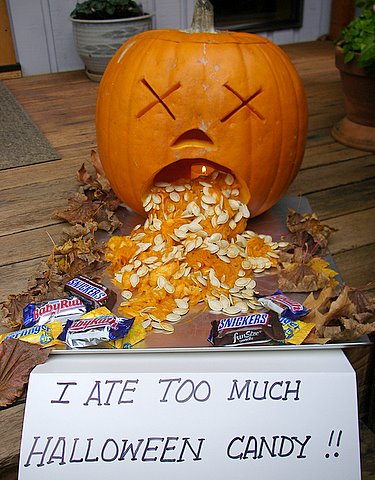
My Dad is a riot
He just sent me these pictures of this year's jack-o'-lantern, on my parents' front porch:



Thursday, November 02, 2006
Fair or unfair? (Or is that not the question?)
As I mentioned earlier, my department is currently running a couple of job searches. Although I'm not on either committee, I still hear chatter about the applicant pool--and I have one colleague who keeps popping into my office, application files in hand, and saying, "Firstname Lastname. Know 'em?"
Since they're always INRU PhDs, of course I always know them. However, since neither of our searches is in my field, and since most of the applicants are a couple of years behind me, I generally don't know their work; when asked about them, then, I've admitted the limits of my knowledge while still being genially enthusiastic: "Oh, s/he's great, just great. Very smart, hard-working, a lovely human being." But today a name came up belonging to someone who has a, shall we say, problematic personality--problematic to a degree that would be apparent even in a 30-minute interview, or possibly even over the phone. So I said, all faux-judiciously, "Well, you're the one reviewing the files, and of course I don't know his/her work . . . but if the question is just about collegiality, Person Y wouldn't be my first choice. All other things being equal, I'd definitely go with Person X."
And then a few hours later my colleague returned with a question about a Person Z, whom I actually know quite well--Z is from my entering class and is someone with whom I had numerous courses, whom I TAed alongside, and whom I get a tremendous kick out of even though we were never very close--and, well, Z is obviously the person I recommended MOST highly, for the simple reason that Z is the person I know best.
On the one hand, this is all perfectly normal and natural and the way that things work in the real world, whether that world be academia or law or Wall Street; connections are what make the world go 'round. When I was on the market, I knew that I was likely to get MLA interviews with schools where the search chair or a committee member had a degree from INRU--and whaddaya know? I almost always did.
Moreover, I trust my colleagues to make thoughtful decisions, and I'm happy to have some little knowledge that might be useful to them. All the same, when you've already received more than 200 applications for a position, you probably do what you can to weed through the pile as quickly as possible--which means that I can't help but feel a few twinges about what my casual remarks could potentially do to someone's candidacy. I also can't help but have noticed that my department, like so many others, has a lot of "duplicates": faculty members with degrees from the same institution. In fact, two of this year's new hires have doctorates from the same institutions as faculty who were hired just the previous year. (I'm the only INRU PhD in the department, but I'm one of three faculty who hold INRU BAs.)
Now, if a grad program is good, the likelihood of hiring multiple people from that program is obviously going to be higher--but I don't happen to think that the laws of the job market follow the laws of probability all that closely.
I've ranted about this elsewhere, but when I started my PhD program, our entering classes were absurdly un-diverse. 10 students came in every year, and always from essentially the same 10-15 schools. Year after year, with just one or two wildcards--someone from a midwestern liberal arts college, say, or from a flagship state school that wasn't a top doctoral institution. [I should note that this doesn't hold true any longer, or at least not to this degree; I've been pleasantly surprised by the range and variety of entering students in the last few years.]
And the thing is, I really don't think that it was snobbery, or at least not conscious snobbery; I think that it was laziness. If you're a harried committee member, and you get an application from someone who's got an undergrad degree from a place you consider a peer institution--where your friends teach, or taught, or got their degrees from--you feel like you know what it's about: you have a sense of who the faculty are, what kinds of students attend, and what the courses in the major looks like. It's just easier than wondering whether Northeastern Montana State U has a rigorous course of study, or who this person writing a rec letter is--and it's certainly easier than (*gasp!*) actually trying to evaluate each candidate on his or her own merits.
It's not that my fellow grad students weren't very, very smart. They were; some of them were even brilliant. But it still felt unfair to me, and I continue to wonder whether I'd have gotten into my program myself, had I not attended one of the approved institutions.
So, I worry, just a little bit about perpetuating that kind of unfair advantage at my new institution, even while I'm genuinely convinced of the awesomeness of most of my grad school colleagues. I want them to do well, and I'm certainly personally invested in seeing that we hire new people as fantastic as those we already have. And yet. . . !
Since they're always INRU PhDs, of course I always know them. However, since neither of our searches is in my field, and since most of the applicants are a couple of years behind me, I generally don't know their work; when asked about them, then, I've admitted the limits of my knowledge while still being genially enthusiastic: "Oh, s/he's great, just great. Very smart, hard-working, a lovely human being." But today a name came up belonging to someone who has a, shall we say, problematic personality--problematic to a degree that would be apparent even in a 30-minute interview, or possibly even over the phone. So I said, all faux-judiciously, "Well, you're the one reviewing the files, and of course I don't know his/her work . . . but if the question is just about collegiality, Person Y wouldn't be my first choice. All other things being equal, I'd definitely go with Person X."
And then a few hours later my colleague returned with a question about a Person Z, whom I actually know quite well--Z is from my entering class and is someone with whom I had numerous courses, whom I TAed alongside, and whom I get a tremendous kick out of even though we were never very close--and, well, Z is obviously the person I recommended MOST highly, for the simple reason that Z is the person I know best.
On the one hand, this is all perfectly normal and natural and the way that things work in the real world, whether that world be academia or law or Wall Street; connections are what make the world go 'round. When I was on the market, I knew that I was likely to get MLA interviews with schools where the search chair or a committee member had a degree from INRU--and whaddaya know? I almost always did.
Moreover, I trust my colleagues to make thoughtful decisions, and I'm happy to have some little knowledge that might be useful to them. All the same, when you've already received more than 200 applications for a position, you probably do what you can to weed through the pile as quickly as possible--which means that I can't help but feel a few twinges about what my casual remarks could potentially do to someone's candidacy. I also can't help but have noticed that my department, like so many others, has a lot of "duplicates": faculty members with degrees from the same institution. In fact, two of this year's new hires have doctorates from the same institutions as faculty who were hired just the previous year. (I'm the only INRU PhD in the department, but I'm one of three faculty who hold INRU BAs.)
Now, if a grad program is good, the likelihood of hiring multiple people from that program is obviously going to be higher--but I don't happen to think that the laws of the job market follow the laws of probability all that closely.
I've ranted about this elsewhere, but when I started my PhD program, our entering classes were absurdly un-diverse. 10 students came in every year, and always from essentially the same 10-15 schools. Year after year, with just one or two wildcards--someone from a midwestern liberal arts college, say, or from a flagship state school that wasn't a top doctoral institution. [I should note that this doesn't hold true any longer, or at least not to this degree; I've been pleasantly surprised by the range and variety of entering students in the last few years.]
And the thing is, I really don't think that it was snobbery, or at least not conscious snobbery; I think that it was laziness. If you're a harried committee member, and you get an application from someone who's got an undergrad degree from a place you consider a peer institution--where your friends teach, or taught, or got their degrees from--you feel like you know what it's about: you have a sense of who the faculty are, what kinds of students attend, and what the courses in the major looks like. It's just easier than wondering whether Northeastern Montana State U has a rigorous course of study, or who this person writing a rec letter is--and it's certainly easier than (*gasp!*) actually trying to evaluate each candidate on his or her own merits.
It's not that my fellow grad students weren't very, very smart. They were; some of them were even brilliant. But it still felt unfair to me, and I continue to wonder whether I'd have gotten into my program myself, had I not attended one of the approved institutions.
So, I worry, just a little bit about perpetuating that kind of unfair advantage at my new institution, even while I'm genuinely convinced of the awesomeness of most of my grad school colleagues. I want them to do well, and I'm certainly personally invested in seeing that we hire new people as fantastic as those we already have. And yet. . . !
Subscribe to:
Posts (Atom)